
25 hours with StarRupture
Arcadia-7 Is A Playground

At first glance, StarRupture feels like a cynically engineered product specifically built to succeed on Steam. Instead of following the typical approach of betting on a successful genre and putting a unique twist on it— imagine any of the bazillion of deckbuilders available on the platform—, Creepy Jar grabbed a few of the most played subgenres and mixed them together into a single smorgasbord.
Except there is nothing cynical about StarRupture, and while there certainly was some financial impetus behind choosing successful genres to mix, Creepy Jar combined them because they’re simply fun to experience. In StarRupture, you’re a child filled with wonder and Arcadia-7 is your playground.
What exactly are the ingredients that make up this smorgasbord, though? The tags present in the game’s Steam page are:
Early Access
Base Building
Survival
Co-op
Open World
And the ones which I would add:
Automation
FPS
Tower Defense
So you can probably tell why a first glance gives such a cynical impression. How does all of this work together to form a functioning videogame?
Let’s imagine StarRupture as a pyramid built using multiple blocks of differing sizes. Despite the tutorial kicking you off with base building and automation, these aren’t what I would consider the blocks which serve as the game’s— and the pyramid’s— base. The first block sustaining the entire Creepy Jar construction is exploration.
Block One- Exploration
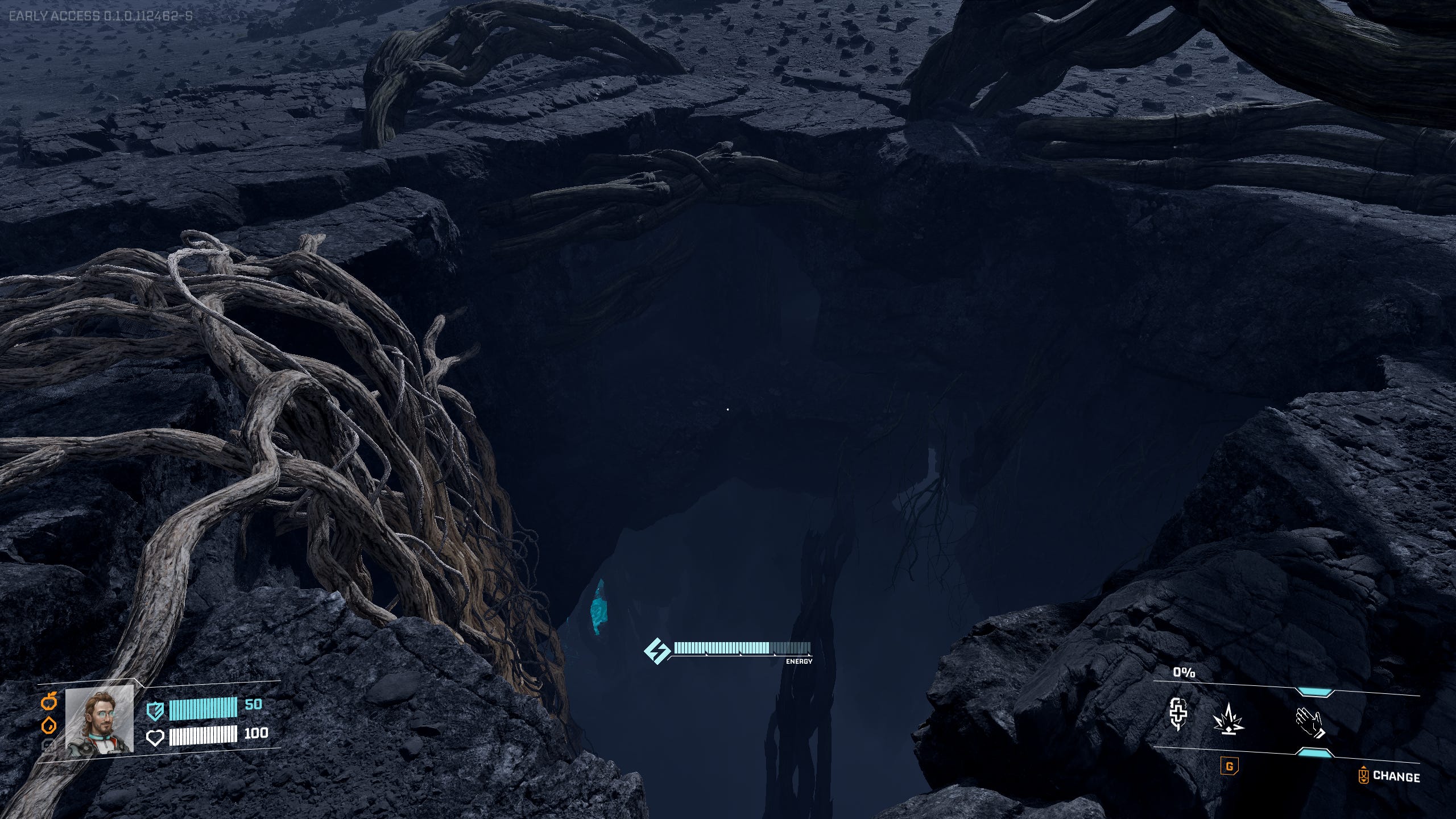
You, the player, are dropped into Arcadia-7, an alien yet familiar world, in a similar way to the character you choose to embody. Whichever convict you end up choosing (Biologist, Engineer, Scientist, or Soldier), you’ll always be someone who’s dropped into a location with very limited information regarding it.
Both of you know that every few real life minutes and in-game hours, the star illuminating this planet goes into some sort of solar eruption completely erasing all life from Arcadia-7’s surface. Soon after, though, the planet regenerates completely.
The Exploration gameplay loop is directly limited by the recurring solar eruptions. While the planet isn’t being incinerated, you’re free to explore the many wonders spread throughout Arcadia-7.
You’ll encounter abandoned bases overtaken by aliens, half-destroyed, or completely infected. You’ll bump into caves which can only be explored during the time following a rupture event, before the vines that block its entrance regrow. Dead bodies of previous explorers lie sprinkled through the landscape hiding precious resources.
But the most valuable treasures are always found in the aforementioned decrepit bases, which also house the only real sources of information that you— the player and the character— get, via written and audio entries from previous colonizers. Every time a ruptura is about to happen, your AI companion warns you, giving you a couple minutes to run back to your base, which brings us to the two next blocks in our pyramid.
Blocks Two And Three- Base Building And Automation
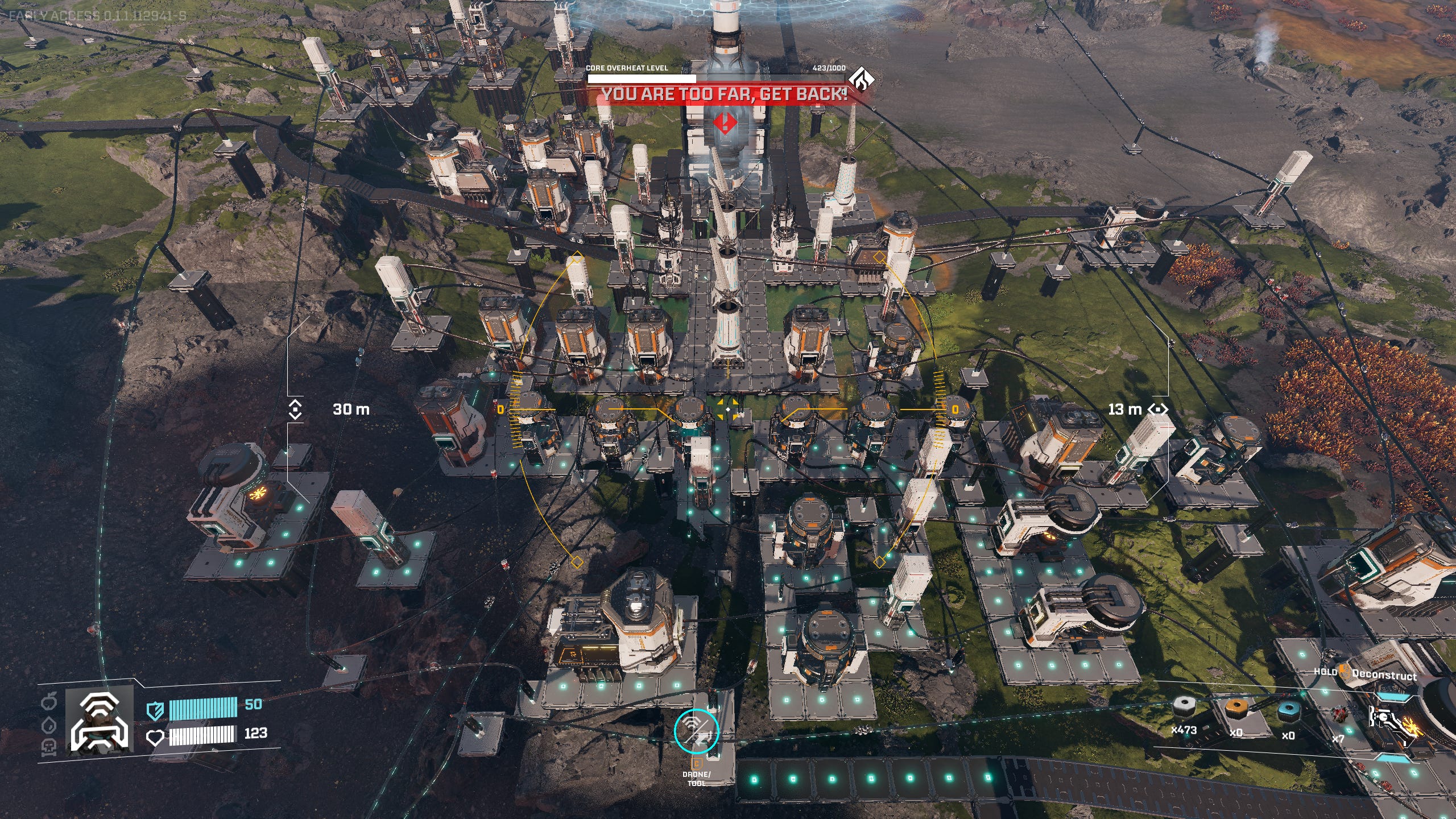
Most of the goodies you’ll find in your explorations of Arcadia-7 serve to feed the blocks present in our pyramid’s second floor. Your base is where you build your habitat, the only building able to protect you from the inferno that is the ruptura.
Inside that same habitat, you’ll build multiple structures directly fed by the exploration loop. Items found throughout the planet can be consumed at the Analysis Station for some Data Points. These can then be used to learn new recipes at the Recipe Station, or to further progress the trust level of the five corporations investing resources into Arcadia-7.
Recipes allow you to craft new buildings and new items produced by those same buildings. But unlike in Creepy Jar’s previous title, Green Hell, you’re not actively crafting these items. Instead, you’re building your base with automation in mind.
When building an efficient base, you’ll create a system which automatically feeds five different Orbital Cargo Dispatchers, one per corporation. These will export the items which the corporations demand, netting you Data Points per item sent. The Data Points automatically level your trust factor with that corporation, eventually taking you to the next level.
Doing so gets you new items, recipes, building, and serves as the game’s main progression. Your character does get stronger depending on your action, akin to an RPG system, but that isn’t nearly as impactful as the unlocks you receive from the corps.
The thing is, every time you level a corporation up, it will demand new items. The only ways to get access to these items are to progress with the other corporations or, more often than not, finding blueprints while exploring.
But your exploration of the planet isn’t only impacted by the cyclical ruptura. You’ll have to fight off the hostile lifeforms that call Arcadia-7 their home, which brings us to the pyramid’s third floor.
Block Four- Combat
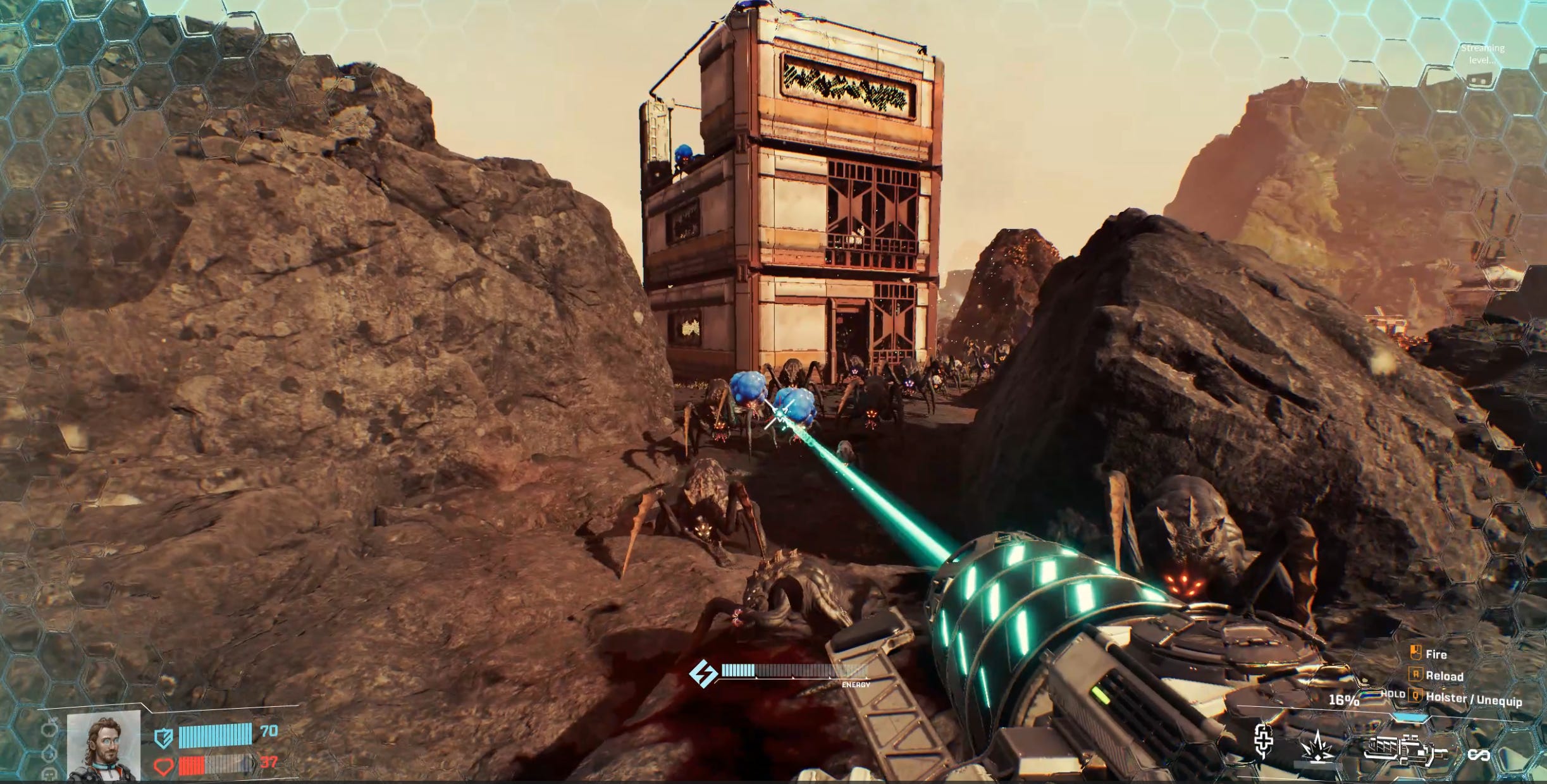
Hostile lifeforms are present everywhere in Arcadia-7, but even more so in points of interest. Every time you get into an abandoned base, hordes of aliens will pop out of the soil.
You can carry two of the following:
UPP 7 “Reaper” Pistol
Mar-9 “Phantom” Assault Rifle (AR)
SLAMS-12 Shotgun
M175 “Grim” Light Machine Gun (LMG)
They play as you expect them to, but you can invest into weapon mods to change their playstyles. The AR works well as an all-rounder and is the best long-range weapon in the game. The Shotgun excels at close range, especially when dealing with hordes of squishy aliens. The LMG also works at close range, but more-so when mowing down tankier aliens, like the Slashers.
While you can deal with the majority of the aliens by standing your ground and shooting, there is one pesky enemy that doesn’t go down so easily: the Goliath. These massive Vermin have two heavily-armored claws which protect them from almost all incoming damage, so the only way to effectively kill them is to hit them from behind.
So even in this beginning phase of the Early Access, StarRupture already boasts decent enemy variety and a good combat system featuring grenades, a dodge button, a medpack which is charged by killing enemies, and a stamina bar.
You’ll also have to deal with these Vermin attacking your base in the aforementioned Tower Defense sections of the game, which will happen every once in a while after you upgrade your Base Core. In addition to the core combat loop, you get access to automated turrets to help you keep the aliens at bay.
This fourth block of the pyramid serves its purpose by bringing some sense of danger and variety to the exploration, but also by showing that not even the Vermin are safe from the cyclical ruptura. If you venture out into Arcadia-7 before it is finished regenerating, you won’t find a single Vermin around.
Even if you head into an abandoned base or activate a Geo-Scanner— a device which reveals a large portion of the map but summons a horde of Vermin—, you won’t encounter a single alien. This is a great example of “show, don’t tell”, regarding how the entire ecosystem of Arcadia-7 revolves around this cyclical cataclysmic event. But how do we learn more about this bizarre planet?
Block Five- Story
As expected for an Early Access title, StarRupture’s story isn’t complete. I won’t go into it here since I want to keep this review as spoiler-free as I can, and because you can’t exactly gauge a story until it is finished.
But what we have so far is intriguing enough, and it serves as an extra incentive to keep us exploring. Crucially, it also fleshes out an already interesting world, leaving us with a lot of questions.
What it proves above all else, though, is the genius behind StarRupture, and what makes Creepy Jar a uniquely capable studio to make this ambitious project work. StarRupture can indeed be viewed as a four-storied pyramid made up of five blocks. It looks more or less like this:
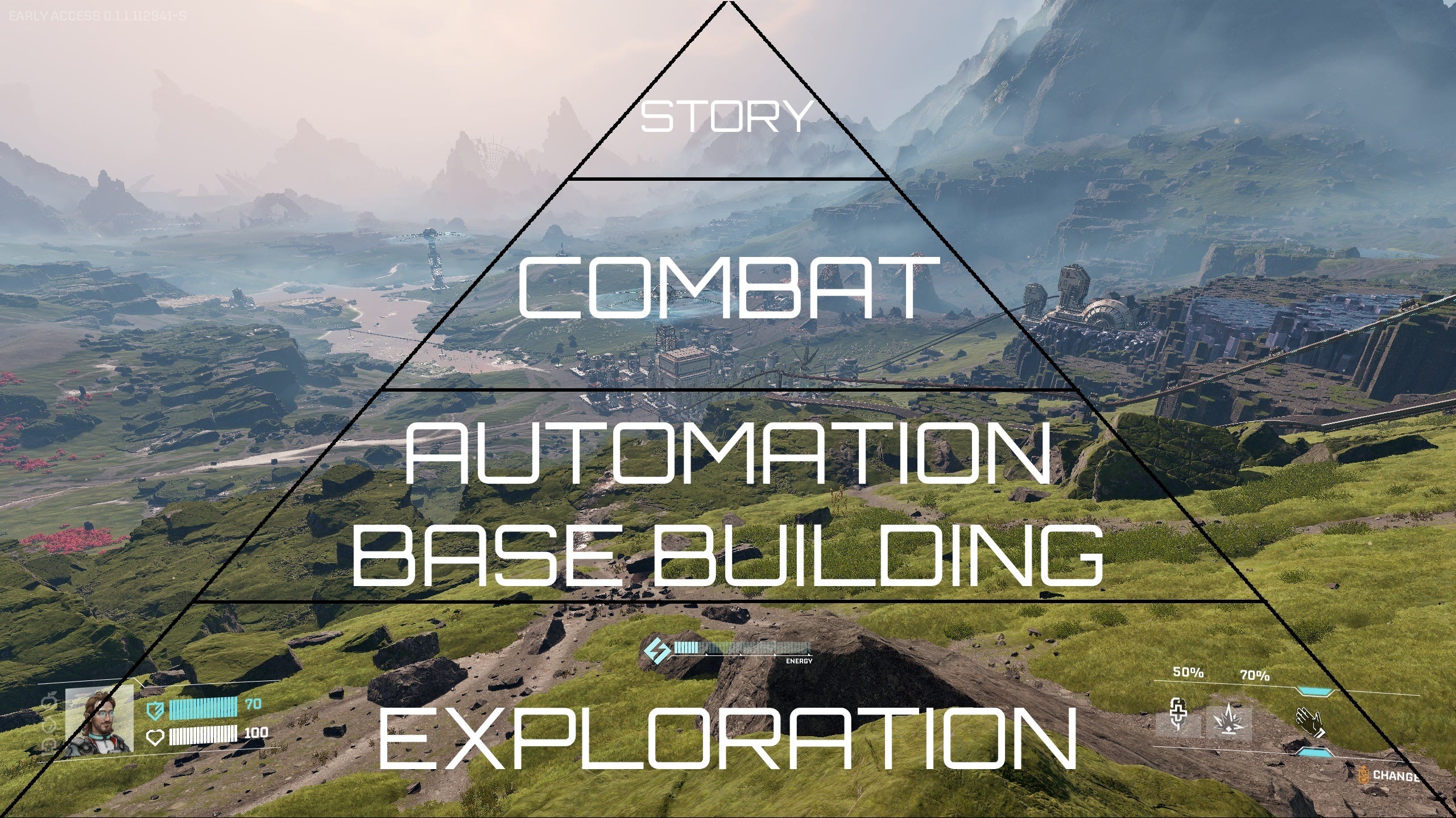
But like the optimized automation base, every component connects to another, creating a genuinely addictive gameplay experience.
Loop Within A Loop
If you’re as lazy about optimization and visual fluidity as me, your StarRupture base will look like a spaghetti monster. Any Italian would be proud of the lengths you go to just to avoid breaking a single spaghetti rail.
Funnily enough, these spaghetti monster bases represent quite well what makes StarRupture such an intoxicating experience. No matter how messy it might look on its surface, everything connects and works into a cohesive whole.
At the base of the pyramid, exploration keeps everything alive. But that exploration only exists because there is a purpose to it: to collect resources that improve your base and further optimize the automation system. To keep that exploration engaging and stressful, you have the top blocks of combat and story, bringing variety to the experience. But these also only work because they directly feed the blocks below them.
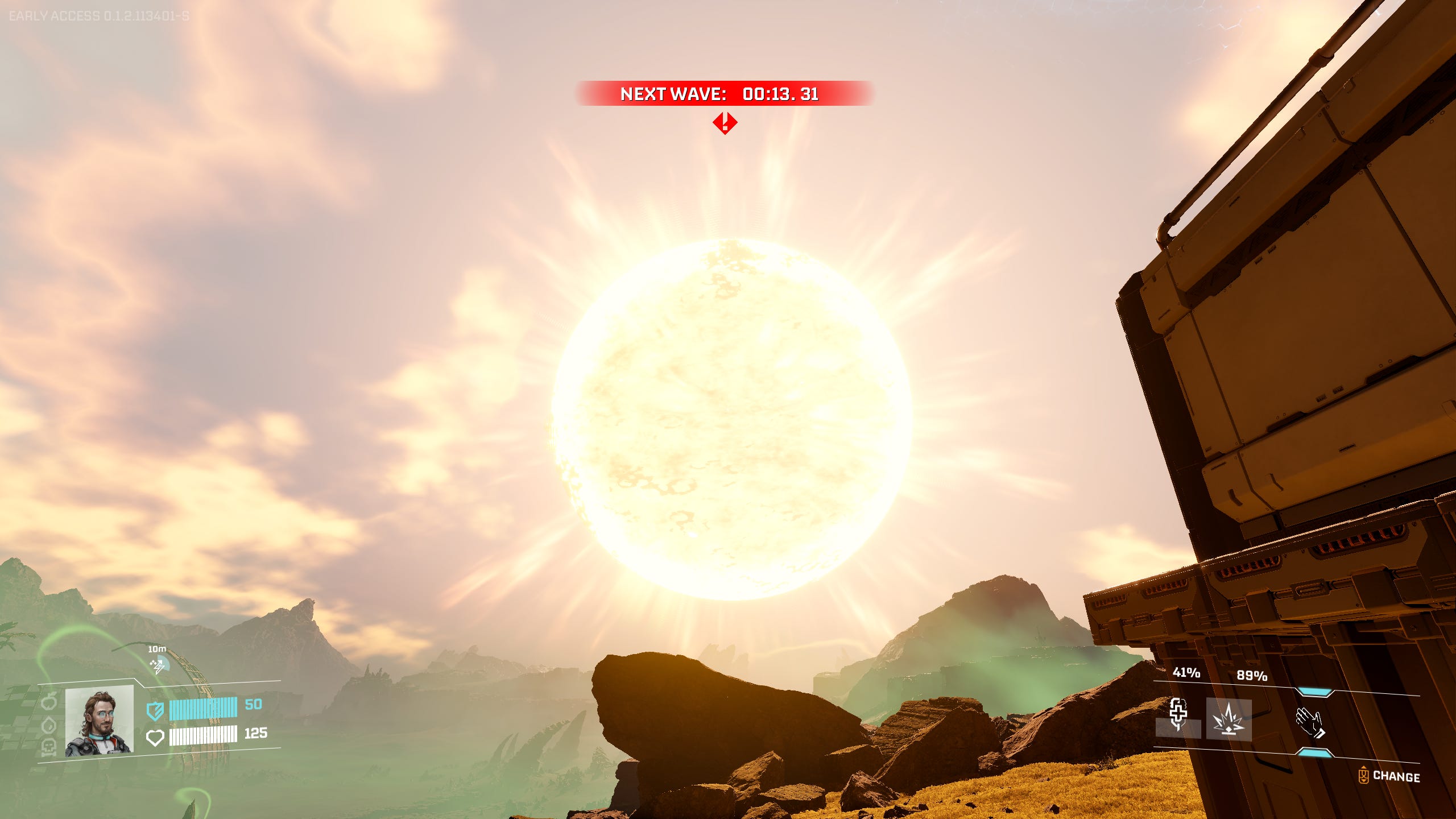
Every block of this pyramid has been done better by another game out there. Reddit will be quick to tell you that Satisfactory did 3D automation much better. Most FPS out there feature better combat. The story, by itself, is serviceable when compared to narrative-focused linear experiences. The open world is fun to explore, but doesn’t remotely reach the heights of giants like Skyrim. Base building is fine, but much clunkier and more limited than something like Dune: Awakening.
But no other game has built a pyramid with such tightly connected diverse blocks like StarRupture. There is no part of this game that jumps out as uniquely awesome, but the experience as a whole really turns Arcadia-7 into an unrivalled playground.
So if any of the pyramid blocks caught your attention, give this one a try. You might be surprised to find that you actually like base building, or automation, or FPS combat. And the best part? If you really can’t jive with one of the blocks, just bring a friend, two, or three, and have them do that part for you, while you enjoy focusing on the ones that cater to your preferences.